DTSP Working Group on Out-of-court Dispute Settlement Releases Initial Position Paper for Consultation

Brussels – The Digital Trust & Safety Partnership today published an initial position paper, developed by the DTSP Out-of-court Dispute Settlement (ODS) Working Group, addressing the emerging ODS ecosystem under the EU Digital Services Act (DSA).

The ODS regime creates a marketplace for redress in the EU, with new actors, dynamics and expectations for content moderation. Users, platforms and regulators are navigating unfamiliar ground, which demands a structured effort to identify challenges and build workable solutions.

This initial position paper identifies best practices and proposes solutions to facilitate an ODS regime capable of delivering swift, and cost-effective redress over content moderation disputes at scale. It highlights four foundational principles: consistent expertise and competence, effective abuse safeguards, efficient information exchange and reasonable cost and fee structures. Industry best practices are identified and described for platform onboarding of ODS bodies, user awareness, information collection, and eligibility checks. Key challenges are identified and proposed as possible areas for the development of regulatory guidance.

This paper provides an initial perspective from online platforms, designed for use in consultation with stakeholders in the DSA Article 21 ecosystem. Building an effective and trusted ODS regime requires effective engagement between online platforms, regulators, dispute settlement bodies, civil society, and users. Each holds an important perspective on how ODS functions in practice and their participation and cooperation is necessary to develop approaches that are workable, credible, and ultimately capable of serving the core objective of providing meaningful, accessible, and rights-respecting redress for users of online platforms.

DTSP aims to incorporate comments and suggestions from stakeholder engagements and looks forward to sharing its findings. Feedback on this paper can be provided by email to contact@dtspartnership.org before 15 February, 2026.

About DTSP

The Digital Trust & Safety Partnership is a unique initiative focused on promoting a safer and more trustworthy internet. We are committed to developing, using and promoting industry best practices, assessment methods, and international standards, to ensure consumer trust and safety when using digital services.

DTSP and the Japan Trust & Safety Association Collaborate to Advance Global Online Safety Standards

The Digital Trust & Safety Partnership (DTSP) and the Japan Trust & Safety Association (JTSA) today announced the signing of a Memorandum of Understanding (MOU) to work together in support of a safer and more trustworthy digital ecosystem in Japan and across the Asia-Pacific region.

Through this partnership, DTSP and JTSA will undertake joint outreach in support of international standard ISO/IEC 25389, the Safe Framework, working in collaboration with peer organizations to promote greater understanding and implementation of this international standard among stakeholders in Japan and across the Asia-Pacific region.

By combining DTSP’s globally applicable best practices and standards with JTSA’s deep knowledge of the Japanese digital ecosystem, the organizations will promote knowledge exchange, international collaboration, and the uptake of practices and standards that will improve online safety for users of a wide range of digital products and services.

“Ensuring user safety is a global challenge that requires strong and trusted partnerships,” said DTSP Executive Director David Sullivan. “We look forward to working closely with our colleagues in Japan to advance responsible and effective trust and safety practices.”

“Japan is experiencing rapid growth in digital services across many sectors, and the need for trust and safety practices that align with internationally recognized standards continues to increase,” said Takeaki Kanaya, Representative Director of JTSA. “By collaborating with DTSP—and by working in partnership with peer organizations across the Asia-Pacific region—we hope to contribute to a broader, shared effort to make online environments safer and more trustworthy.”

On Tuesday 25 November, JTSA will present the Safe Framework as part of a session on trust and safety at Internet Week 2025, one of Japan’s most established internet conferences. JTSA and DTSP will begin planning future joint activities and share updates on future collaborative projects.

About DTSP

The Digital Trust & Safety Partnership is a unique initiative focused on promoting a safer and more trustworthy internet. We are committed to developing, using and promoting industry best practices, assessment methods, and international standards, to ensure consumer trust and safety when using digital services.

About JTSA

The Japan Trust & Safety Association (JTSA) is Japan’s first cross-industry organization dedicated to advancing online trust and safety. JTSA brings together leading technology companies, platforms, researchers, and civil society partners to strengthen responses to emerging digital risks and promote the adoption of global best practices and standards. Through research, capacity building, and collaboration with peer organizations in Japan and abroad, JTSA supports efforts to build safer and more trustworthy digital ecosystems for all users.

Digital Trust & Safety Partnershipと一般社団法人トラスト&セーフティ協会、国際的なオンライン安全標準の推進に向け協働を開始

Digital Trust & Safety Partnership(DTSP)と一般社団法人トラスト&セーフティ協会(JTSA)は本日、日本およびアジア太平洋地域における、より安全で信頼できるデジタルエコシステムの実現を目指した協力関係を構築するため、覚書(MOU)を締結したことを発表します。

本パートナーシップを通じて、 DTSPとJTSAは国際標準 ISO/IEC 25389「Safe Framework」の普及・実装促進に向けた共同アウトリーチを行います。この国際標準の普及・啓発と実装支援を進めるにあたり、両団体は日本およびアジア太平洋地域の関連団体とも協力しながら取り組みを進めてまいります。

DTSP が持つ国際的に適用可能なベストプラクティスや標準と、JTSA が有する日本のデジタルエコシステムに関する深い知見を組み合わせることで、両団体は知識共有、国際協働、そして幅広いデジタルサービスにおけるオンライン安全の向上につながる実務や標準の普及を推進します。

DTSP の David Sullivan エグゼクティブ・ディレクターは次のように述べています。

「ユーザーの安全確保は世界共通の課題であり、強く信頼できるパートナーシップが欠かせません。日本の皆様と緊密に連携し、責任ある効果的なトラスト&セーフティの実践を推進できることを大変嬉しく思います。」

JTSA の代表理事 金谷武明 は次のように述べています。

「世界的な潮流と同様に、日本でも多くの分野でデジタルサービスの普及が進む中で、国際的に認められた標準に整合するトラスト&セーフティの実践が、これまで以上に求められています。DTSPとの協働を基盤に、アジア太平洋地域の関連団体とも連携しながら、より安全で信頼できるオンライン環境を実現するための広範な共同の取り組みに貢献していきたいと考えています。11月25日(火)、JTSA は日本の歴史あるインターネットカンファレンスの一つである「Internet Week 2025」のトラスト&セーフティ関連セッションにおいて、Safe Framework を紹介する予定です。JTSA と DTSP は今後、共同活動の計画策定を進め、順次その取り組みを発信していきます。

Digital Trust & Safety Partnershipについて

Digital Trust & Safety Partnership(DTSP)は、安全で信頼できるインターネットの実現を目指す国際的なイニシアチブです。デジタルサービスの利用者が安心して利用できるよう、業界のベストプラクティス、評価手法、国際標準の策定・普及に取り組んでいます。

一般社団法人トラスト&セーフティ協会について

一般社団法人トラスト&セーフティ協会(JTSA)は、日本初の業界横断型のトラスト&セーフティ専門団体です。プラットフォーム企業、研究者、非営利組織など多様なステークホルダーが協働し、新たなデジタルリスクへの対応強化や、国際的なベストプラクティス・標準の普及を推進しています。研究、能力開発、国内外の関連団体との連携を通じ、安全で信頼できるデジタル環境の構築に取り組んでいます。

DTSP Announces New Working Group on Out-of-Court Dispute Settlement

New Initiative Will Develop Industry Best Practices and Proposals Under Article 21 of the EU Digital Services Act

Brussels – The Digital Trust & Safety Partnership (DTSP) is excited to announce the formation of a Working Group on Out-of-Court Dispute Settlement under Article 21 of the European Union’s Digital Services Act (DSA). The group will explore the development of industry best practices and proposals to address challenges presented by the emerging system of out-of-court dispute settlement bodies.

“Out-of-court Dispute Settlement is a significant part of the DSA, introducing a system for users to resolve content moderation disputes with online platforms,” said DTSP Executive Director David Sullivan. “This Working Group will help companies navigate this new dispute settlement system, and help ensure the process works effectively and benefits users of these services.”

The Working Group will collect examples of effective implementation, identify opportunities to improve, develop proposals, and engage with stakeholders to address challenges presented by the emerging out-of-court dispute settlement ecosystem in the EU.

Joining DTSP to facilitate this working group is Jonny Shipp. A trusted independent adviser to companies, government and think-tanks, Jonny Shipp was founder and Executive Chair of the Internet Commission until its acquisition by the Trust Alliance Group in 2022. As a Visiting Fellow at London School of Economics from 2016 – 2024, he contributed to the creation of the DSA and other online safety regulations, and has taken a particular interest in Article 21 of the DSA. Before that, he served six years as the Industry Vice-Chair, Internet Watch Foundation and for 14 years he held leadership roles at the Spanish multinational telecommunications company, Telefónica.

Jonny Shipp said, “DTSP’s proven ability to lead the trust and safety agenda makes it the natural partner for online platforms interested in making a success of this novel part of the European trust and safety landscape. I am delighted to have the opportunity to facilitate this new Working Group and support the successful implementation of the DSA Out-of-court Dispute Settlement process.”

The initiative reflects DTSP’s ongoing commitment to fostering a safer and more trustworthy internet. By bringing together leading companies, the Working Group aims to support collective efforts to create a safer digital environment.

About DTSP

The Digital Trust & Safety Partnership is a unique initiative focused on promoting a safer and more trustworthy internet. We are committed to developing, using and promoting industry best practices, assessment methods, and international standards, to ensure consumer trust and safety when using digital services.

GNI and DTSP Publish Summary Report of 2025 European Rights & Risks: Stakeholder Engagement Forum

Today, the Digital Trust & Safety Partnership (DTSP) and the Global Network Initiative (GNI) are releasing a high-level summary of key themes, learnings, and recommendations from the “2025 European Rights & Risks: Stakeholder Engagement Forum,” held in Brussels on 3 and 4 June. While in Brussels, GNI and DTSP also held a pre-event with regulators prior to the Forum on ‘Centring Human Rights in Online Risk Regulation’.

Read the Event Summary Report

Very Large Online Platforms and Search Engines (VLOPs and VLOSEs) in the European Union are currently undertaking their annual round of systemic risk assessments under the EU Digital Services Act (DSA). Due to be submitted to the European Commission in August 2025 and published in November, these assessments are intended to identify risks arising from platform services, the mitigations that have been put in place to reduce those risks, and the outcomes of external audits.

This year’s Forum convened more than 75 participants, including representatives from eight service providers who are members of GNI and DTSP, and collectively manage 14 designated VLOPs or VLOSEs. The event also brought together civil society and academic experts from across Europe and beyond to reflect on risk assessment practices, the evolving DSA regulatory landscape and ensuring proportionality of government action.

Over two days of plenary panels and break-out workshops, participants explored several priority themes, including:

  • Embedding human rights-based approaches in risk assessment and mitigation;
  • Centering product design and platform function in assessing risks;
  • Better integrating civil society input, especially on proportionality and impacts;
  • Using data and metrics to evaluate effectiveness and support continuous learning;
  • Addressing persistent challenges in meaningful stakeholder engagement;
  • Clarifying the role of DSA audits;
  • Strengthening coherence across risk-based regulatory frameworks.

The Forum offered a timely opportunity to take stock of lessons from the first round of published risk assessments and to anticipate future opportunities for strengthening rights-respecting regulatory implementation. Participants discussed persistent gaps in transparency, definitional clarity, and cross-platform accountability and discussed promising practices that can support better mitigation design and stakeholder engagement in the future.

If you are interested in engaging further on this work, please reach out to us at info@globalnetworkinitiative.org and contact@dtspartnership.org.

DTSP’s Safe Framework Published as an International Standard

Transposed as ISO/IEC 25389, the Safe Framework is the first international standard for digital safety across diverse products and services

Washington – The Digital Trust & Safety Partnership (DTSP) today announced that its Safe Framework Specification has been formally published as an international standard, ISO/IEC 25389. The standard, which is the first of its kind, was developed within the Joint Technical Committee 1 of the International Organization for Standardization (ISO) and International Electrotechnical Commission (IEC) for information technology (JTC 1). 

This milestone affirms DTSP’s leadership in creating a safer digital environment. The newly adopted standard offers a structured framework for organizations that provide public-facing digital products or services to manage content- or conduct-related risks. 

“This new international standard provides a framework to help ensure a safer online experience when using digital products and services,” said DTSP Executive Director David Sullivan. “It is the result of a collaborative effort by DTSP partners and will help to create a safer digital environment for everyone.”

ISO/IEC 25389 includes updated versions of the DTSP framework of best practices for trust and safety as well as its pioneering method for assessing the maturity of an organization’s digital safety practices. The ISO/IEC 25389 framework also provides a flexible set of aims for managing content- and conduct-related risks, allowing digital services to map their specific practices to these overarching commitments.

In January 2025, the Safe Framework was decisively approved in a vote by national standards bodies from all over the world. Looking ahead, DTSP will retain control and be responsible for the maintenance of the Safe Framework, including future review of the international standard with broad stakeholder consultation and public input. 

“Congratulations to DTSP on the publication of ISO/IEC 25389. I’m looking forward to future collaboration between ISO/IEC JTC 1 and DTSP,” said Phil Wennblom, chair of ISO/IEC JTC 1.

The publication of ISO/IEC 25389 underscores DTSP’s increased engagement with standards bodies relevant to trust and safety. Since 2023, DTSP has served as a liaison to the ISO/IEC JTC subcommittee responsible for information security, cybersecurity, and privacy protection (SC 27), actively contributing to standards under development for age assurance. 

About DTSP

The Digital Trust & Safety Partnership is a first-of-its kind initiative focused on promoting a safer and more trustworthy internet. The Digital Trust & Safety Partnership includes Apple, Bitly, Bumble, Cantina, Discord, Google, LinkedIn, Match Group, Meta Platforms, Inc., Microsoft, Pinterest, Reddit, TikTok, and Twitch. For more information, visit dtspartnership.org.

DTSP at the 2025 Internet Governance Forum

The Digital Trust & Safety Partnership (DTSP) will be at the 20th meeting of the Internet Governance Forum, in in Lillestrøm, Norway, from June 23 to June 27, 2025. DTSP executive director David Sullivan will be in present and looks forward to meeting with interested stakeholders from the global internet governance community.  

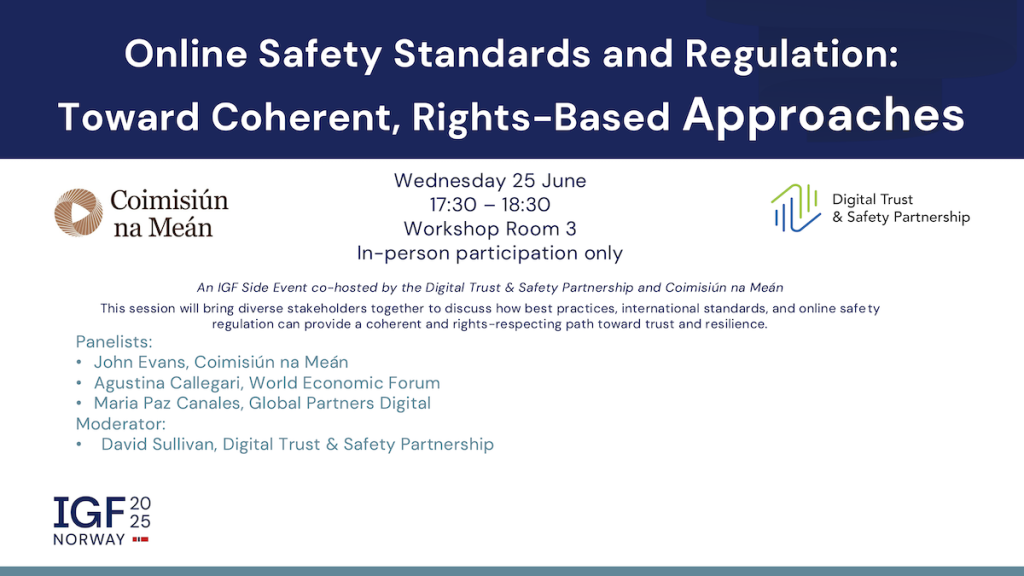
DTSP is holding a Side Event, “Online Safety Standards and Regulation: Toward Coherent, Rights-Based Approaches,” on Wednesday, 25 June at 17:30 – 18:30 (Workshop Room 3). Co-organized by Coimisiún na Meán, Ireland’s independent media regulator, this session will bring diverse stakeholders together to discuss how best practices, international standards, and online safety regulation can provide a coherent and rights-respecting path toward trust and resilience.

The discussion will feature the following panelists:

  • David Sullivan, DTSP (moderator)
  • John Evans, Coimisiún na Meán (CnaM)
  • Agustina Callegari, World Economic Forum Global Coalition for Digital Safety (WEF)
  • Maria Paz Canales, Global Partners Digital (GPD)

RSVP for the side event here.

David will also speak at the session, “Generative AI & LLMs in Content Moderation: Rights & Risks,” on Tuesday 24 June at 16:00 CEST (Workshop Room 3).

Centering the Protection of Human Rights in Online Risk Regulation

In Brussels on Tuesday 3rd June, the Global Network Initiative (GNI) and the Digital Trust & Safety Partnership (DTSP) hosted “Centering the Protection of Human Rights in Online Risk Regulation,” a multistakeholder gathering of companies, civil society, academics, and online safety regulators.

A keynote presentation by Silvia Fukouka, Principal, Governance and Risk Management Policy at UK Office of Communications (Ofcom) – slides below – was followed by a multistakeholder panel discussion held under the Chatham House Rule with participation from Ofcom, Coimisiún na Meán (Ireland’s media regulator and Digital Service Coordinator), the European Commission’s Directorate-General for Communications Networks, Content and Technology (DG Connect), CDT Europe, and the Centre for Communication Governance at National Law University Delhi.

Ofcom Presentation on Risk Assessment under the UK Online Safety Act

This event was followed by the third iteration of the European Rights & Risks Stakeholder Engagement Forum, where representatives from very large online platforms and search engines and experts from civil society and academia discussed systemic risk assessments and mitigations under the EU Digital Services Act (DSA). This year’s Forum, which took place across two-days of dynamic workshops and panels,sought to enable meaningful stakeholder engagement and ensure that the protection of fundamental rights, especially freedom of expression, is upheld as part of the DSA.

GNI and DTSP are deeply appreciative of all of the stakeholders who helped us prepare for and participated in this year’s Forum. We continue to believe that multistakeholder discussions are critical to enabling rights-respecting approaches to digital risk management, and ensuring that regulatory approaches do not result in disproportionate or unnecessary restrictions on freedom of expression or privacy. We will be publishing an event report consistent with the Chatham House rule shortly and look forward to continuing to engage on these critical topics.

DTSP Releases Spanish And Portuguese Translations Of Its Best Practices

The Digital Trust & Safety Partnership (DTSP), a first-of-its-kind initiative aimed at promoting a safer and more trustworthy internet, is unveiling its best practices translated to Spanish and Portuguese. These translations are designed to expand accessibility and engagement among Spanish- and Portuguese-speaking communities.

The report describes a range of best practices — specifically, five guiding principles for age assurance and three dozen examples of best practices in line with those principles. With the availability of these translated reports, digital service providers in Spanish- and Portuguese-speaking regions can easily implement DTSP’s best practices, enhancing the safety of the digital space.

En Espanol

La Digital Trust & Safety Partnership (DTSP), una iniciativa pionera en su tipo que tiene como objetivo promover un Internet más seguro y responsable, lanza traducciones al español y al portugués de sus programa de prácticas recomendadas. Las traducciones buscan ampliar el alcance del programa y promover una mayor participación por parte de comunidades de habla hispana y portuguesa.

El informe capta una serie de prácticas recomendadas. En particular, incluye cinco líneas directrices a seguir para la verificación de edad y tres docenas de ejemplos de dichas prácticas en base a las líneas directrices. Los proveedores de servicios digitales en regiones de habla hispana y portuguesa podrán ahora implementar las prácticas recomendadas por la DTSP gracias a la disponibilidad de las traducciones, lo que conllevará a una mejora de la seguridad en el mundo digital. 

Leer en español: https://dtspartnership.org/garantia-de-edad-principios-rectores-y-mejores-practicas/

Em Português

A Digital Trust & Safety Partnership (DTSP), uma iniciativa pioneira que visa promover uma internet mais segura e confiável, está lançando suas melhores práticas traduzidas para o espanhol e o português. Estas traduções foram concebidas para expandir a acessibilidade e o envolvimento entre as comunidades de língua espanhola e portuguesa.

O relatório descreve uma série de melhores práticas — especificamente, cinco princípios orientadores para a garantia de idade e três dezenas de exemplos de melhores práticas alinhadas com estes princípios. Com a disponibilidade destes relatórios traduzidos, os provedores de serviços digitais nas regiões de língua espanhola e portuguesa podem implementar as Melhores Práticas do DTSP, fortalecendo a segurança do espaço digital.

 Ler em Português: https://dtspartnership.org/sistema-de-mejores-practicas-2/

DTSP Unveils New Best Practices for Incorporating AI and Automation Into Trust and Safety

Washington – The Digital Trust & Safety Partnership (DTSP) released a first-of-its-kind report outlining best practices for the use of artificial intelligence (AI) and automation in trust and safety operations. Developed by DTSP’s AI and Automation Working Group, with assistance from BSR, the report provides valuable guidance on how to leverage AI to address content- and conduct-related abuse on digital products and services.

“AI and automation offer significant potential to keep users safe by detecting, enforcing and reviewing content and conduct to address online abuse at scale,” said DTSP Executive Director David Sullivan. “Automated tools have been a key part of trust and safety from the very beginning, but recent advances in AI, when deployed responsibly, can increase the capacity and accuracy of efforts to counter abusive content and behavior online.”

The report identifies ways that AI can be used to implement the DTSP Best Practices Framework, across product development, governance, enforcement, improvement, and transparency, including potential opportunities for generative AI to further the practices. After exploring limitations and challenges for AI in trust and safety, the report goes on to identify additional best practices and areas where greater future collaboration is needed.  

The report is a culmination of extensive research, including interviews with participating companies and generative AI experts. Key points include:

  • AI and automation enrich and support the role of trust and safety professionals.
  • Companies offering very different digital products and services are aligned on both the challenges and opportunities for integrating AI and generative AI into their trust and safety operations.
  • When deployed responsibly, AI and automation can enhance all aspects of trust and safety, from product development, to governance, enforcement, improvement, and transparency. AI can also improve the wellbeing of trust and safety teams and reduce their exposure to traumatic content.
  • Generative AI has the potential to significantly increase the capacity and accuracy of content moderation; however, further experimentation and risk assessment and mitigation is needed.
  • Best practices that acknowledge the limitations of AI while encouraging collaboration across the trust and safety field provide a path forward on the internet’s toughest challenges.

The best practices adhere to the DTSP Best Practices Framework and were informed by input from the DTSP AI and Automation Working Group. Members of the working group include Bitly, Bumble Inc., Discord, Google, LinkedIn, Match Group, Meta, Microsoft, Pinterest, Reddit, TikTok, and Zoom. The findings reflect the diverse set of products and services offered by these participants. 

European Rights & Risks: DTSP & GNI Stakeholder Engagement Forum Summary

Today, the Global Network Initiative (GNI) and the Digital Trust & Safety Partnership (DTSP) are publishing a high-level summary of the key learnings and takeaways from the preparation for and discussions during the “European Rights & Risks: Stakeholder Engagement Forum”, which was held in Brussels on 26 and 27 June 2024.

At present, very large online platforms and search engines (VLOPs and VLOSEs) in the European Union are conducting their second round of mandatory risk assessments under the Digital Services Act (DSA). Due this month (August 2024), these assessments seek to identify the platforms’ own “systemic risks,” the mitigations they’ve taken to reduce those risks, and their crisis plans and responses. 

The Forum brought together more than 75 attendees, including representatives from seven entities who are members of GNI and DTSP and collectively manage 13 distinct services that have been designated as VLOPs or VLOSEs, as well as civil society and academic experts from across Europe and other jurisdictions, to discuss systemic risk assessments. 

Discussions during the Forum coalesced around several overarching themes: understanding risks, assessment methodologies, stakeholder engagement, DSA enforcement, the Brussels Effect, and the role of AI. Through deep dives on several risk areas (electoral processes and civic discourse, crisis and conflict-affected settings, and when harmful content becomes illegal), the Forum explored the lack of clarity on what makes a risk “systemic,” especially those with cross-border implications. Across sessions, stakeholders discussed ways civil society expertise could better inform risk assessments. Participants also probed opportunities and challenges around integrating AI into risk assessment and mitigation processes.

This Forum marked one step forward in the journey toward more fruitful engagement between platform companies and civil society in pursuit of the protection of fundamental rights in Europe and around the world. Representatives from digital services and civil society brought diverse perspectives to the discussion, and were able to identify points of common ground despite their at times opposing positions. For instance, as a general matter stakeholders agreed that the lack of authoritative guidance from the European Commission presents opportunities to work collaboratively in pursuit of rights-respecting approaches to risk assessment. Forthcoming public reports on year one risk assessments and audits will provide more opportunities for shared reflection and identification of challenges and opportunities. DTSP and GNI will organize a follow-up, virtual workshop to facilitate additional conversations after those reports are published.  

Read Event Summary